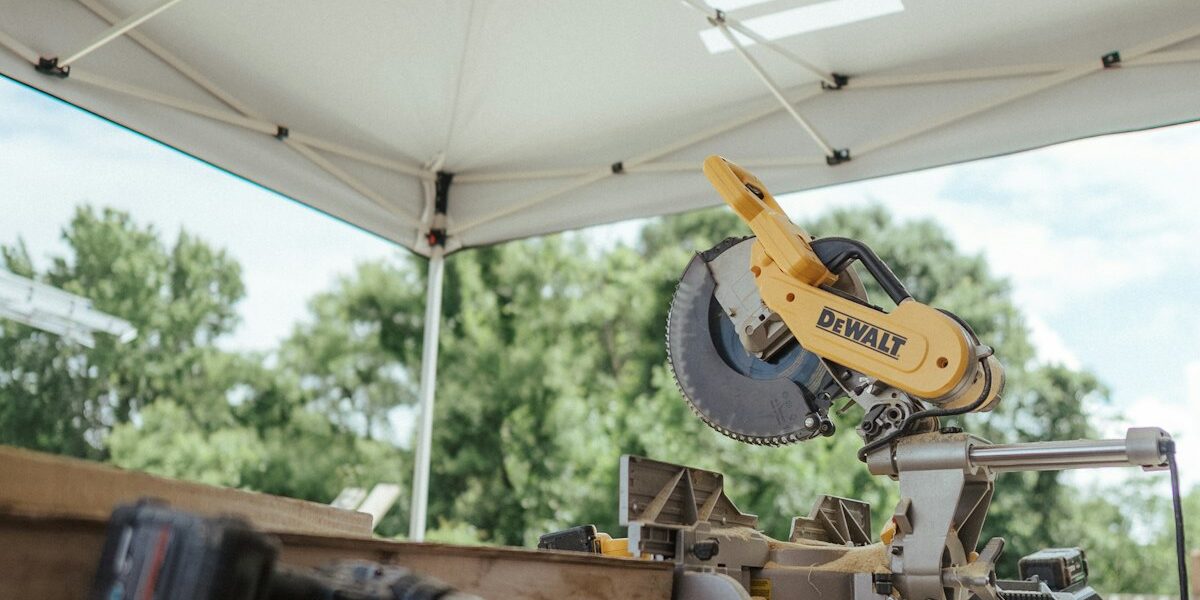
A miter saw without a proper fence and stop block system is just an expensive way to make rough cuts. But add a well-designed station with precise stops and extended fences, and suddenly you’re cutting thirty identical pieces in the time it used to take to measure and mark five.

The Fence Extension Fundamentals
Your miter saw’s stock fence is too short. Period. Even on a 12-inch sliding compound miter saw, the factory fence extends maybe 18 inches on each side. For production work and accurate repeatable cuts, you need at least 4 feet of fence on each side of the blade.
Build the extensions from 3/4″ Baltic birch plywood or MDF. Height should be 4-6 inches to adequately support stock. Attach them to your saw station so the faces align perfectly with the saw’s fence. Use shims if necessary. Any misalignment translates directly to inaccurate cuts.
The fence extensions must be dead straight. Use a long straightedge during installation. A fence that bows even 1/32″ over 4 feet will haunt you on precision joinery.
Stop Block Systems Worth Building
Flip stops are the industry standard for good reason. They swing out of the way for rough cuts, then flip down against a micro-adjustable fence track for repeatable positioning. Commercial flip stops from Incra, Kreg, and Woodpeckers work well. You can also build your own from hardwood and a few hardware-store components.
The key is the track system. T-track mounted to the top of your fence extension lets the stop slide to any position and lock down firmly. Use quality T-track with precision-machined slots. The $8 stuff from the hardware store has too much slop.
Install a self-adhesive measuring tape along the front face of your fence, positioned so you can read the cut length directly at the stop block. This eliminates the tape-measure-and-mark routine entirely.
The Zero-Clearance Insert
Make a zero-clearance insert for your saw table using 1/4″ hardboard. Cut it to fit the existing insert cavity, install it, then lower the blade and slowly raise it through the hardboard at your most common miter angle (usually zero degrees). This eliminates tearout on the bottom of cuts and improves dust collection.
Replace the insert whenever the kerf widens noticeably. This usually happens after 100-200 cuts depending on the materials you’re processing.
Secondary Stops for Common Lengths
If you regularly cut stock to specific lengths, add secondary fixed stops. I’ve got stops permanently set at 16″, 22-1/2″ (for 2×4 studs minus two plates), and 32-3/4″ (common shelf lengths for my cabinet work). Flip stops for variable lengths, fixed stops for high-volume repeats.
Support Wing Design
Long stock needs support. Build support wings that extend at least 4 feet from the blade on each side. These can be simple platforms at the same height as the saw table, or more elaborate telescoping supports for extra-long material.
The critical measurement: the support surface must be exactly level with the miter saw table. Use adjustable leveling mechanisms to dial this in. Check it with a long level spanning from the saw table to the wing. Any sag or rise causes binding and inaccurate cuts.
Dust Collection That Actually Works
Miter saws throw dust everywhere. The stock bag is useless. Build a dust hood behind the blade that connects to your shop’s collection system. A 4-inch port positioned directly behind the cut captures the majority of chips. Add a second port below the table for the fine dust that settles.
Some woodworkers build enclosed miter saw stations with clear polycarbonate fronts. The enclosure contains the spray and routes it to collection. It’s extra work to build but dramatically improves shop air quality.
The Time Savings Are Real
Without a stop system, cutting 20 identical parts means 20 measurements, 20 marks, 20 alignments. With a properly dialed-in stop block, it’s one measurement, set the stop, and cut 20 parts in under three minutes.
Over a year of projects, that time savings adds up to dozens of hours. More importantly, the accuracy improves. Every piece comes out identical because the system eliminates human measuring error.
Invest a weekend in building this station properly. It transforms the miter saw from a rough-cut tool into a precision instrument worthy of fine woodworking.
\n\n
Related Articles
\n



Stay in the loop
Get the latest the workshop journal updates delivered to your inbox.