Today, I will share it all with you.
Wood Glue Comparison Chart
| Glue Type | Open Time | Clamp Time | Full Cure | Water Resistant |
|---|---|---|---|---|
| PVA (Titebond Original) | 5-10 min | 30-60 min | 24 hours | No |
| PVA Type II (Titebond II) | 5-10 min | 30-60 min | 24 hours | Yes (Type II) |
| Waterproof (Titebond III) | 8-10 min | 30-60 min | 24 hours | Yes (Waterproof) |
| Polyurethane (Gorilla) | 10-15 min | 1-2 hours | 24 hours | Yes |
| Epoxy (2-Part) | 5-30 min | 1-4 hours | 24-72 hours | Yes |
| Hide Glue (Liquid) | 3-5 min | 30-60 min | 24 hours | No |
Bond Strength Comparison
| Glue Type | Strength (PSI) | Best For | Limitations |
|---|---|---|---|
| PVA Original | 3,600-4,000 | Indoor furniture, cabinets | Not for outdoor use |
| PVA Type II | 3,750 | Exterior projects, cutting boards | Not fully waterproof |
| PVA Waterproof | 4,000+ | Outdoor furniture, boats | Longer open time needed |
| Polyurethane | 3,500 | Mixed materials, gap filling | Foams, requires moisture |
| Epoxy | 3,000-4,500 | Structural repairs, filling | Not sandable, expensive |
| Hide Glue | 2,500-3,000 | Antique repair, instruments | Heat sensitive |
What I Actually Use
Titebond Original for Everything Indoor
Ninety percent of my work uses plain Titebond Original. The bond is stronger than the wood itself, which means joints fail at the wood, not the glue line. I’ve pulled apart failed practice joints—the wood fibers tear before the glue gives up.
The five to ten minute open time works fine for most joinery if you organize your clamps before you start spreading glue. I learned that lesson the hard way during a panel glue-up that went sideways fast. Now I stage everything first.
Titebond III for Anything That Sees Water
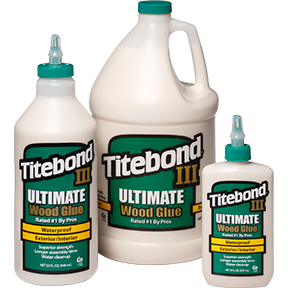
Outdoor furniture, cutting boards, bathroom cabinets—anything with moisture exposure gets Titebond III. The waterproof rating isn’t marketing. I’ve had outdoor benches survive three winters with joints that still look perfect.
It’s also FDA-approved for cutting boards, which matters if you care about that sort of thing. Some people don’t worry about food-safe finishes. I figure if I’m spending hours making a cutting board, I might as well use the right glue.
Titebond II Sits in the Middle
Honestly, I skip Titebond II most of the time. If it’s indoor work, Original is cheaper. If it needs real waterproofing, III is better. II occupies this middle ground that I rarely need.
That said, some woodworkers swear by it for cutting boards because it’s water-resistant and costs less than III. Not a bad choice, just not what I reach for.
Hide Glue for Special Cases
I keep hide glue around for instrument repair and antique restoration. The reversibility matters when you’re working on a 100-year-old chair that might need future repairs. Heat and moisture reactivate it, allowing disassembly without destroying the wood.
The short open time is brutal. Three to five minutes means you need to work fast and have everything ready. Not beginner-friendly, but
Temperature and Application Guide
| Glue Type | Min Temp | Ideal Temp | Cleanup |
|---|---|---|---|
| PVA Glues | 50°F (10°C) | 70-90°F | Water while wet |
| Polyurethane | 40°F (4°C) | 60-80°F | Mineral spirits |
| Epoxy | 50°F (10°C) | 70-85°F | Acetone before cure |
| Hide Glue | 65°F (18°C) | 70-80°F | Warm water |
Cost Reality Check
Glue cost matters less than you’d think for furniture work. A sixteen-dollar bottle of Titebond Original lasts me through multiple projects. Even if you go through a gallon a year, that’s maybe sixty dollars annually.
- PVA Original: Most economical at roughly $0.30-0.40 per ounce
- PVA Type II: Slightly higher at $0.35-0.50 per ounce
- PVA Waterproof: Premium pricing at $0.50-0.70 per ounce
- Polyurethane: Mid-range at $0.40-0.60 per ounce
- Epoxy: Most expensive at $1.00-3.00 per ounce
- Hide Glue: Varies widely, $0.50-1.50 per ounce
Buying gallon jugs makes sense if you work regularly. The per-ounce cost drops by half, and you’re not constantly running out mid-project. I keep Original and III in gallon sizes and pour into squeeze bottles as needed.
The Actual Answer
For most woodworkers, here’s what works:
- General indoor woodworking: Titebond Original or equivalent PVA
- Projects with moisture exposure: Titebond II or Titebond III
- Fully waterproof bonds: Titebond III or marine epoxy
- Gap filling or mixed materials: Polyurethane or epoxy
- Quick repairs: CA glue (super glue)
- Reversible bonds: Hide glue
Buy Titebond Original for indoor furniture. Buy Titebond III for cutting boards and outdoor work. Keep CA glue for repairs. Everything else is specialized enough that you’ll know when you need it.


Stay in the loop
Get the latest the workshop journal updates delivered to your inbox.