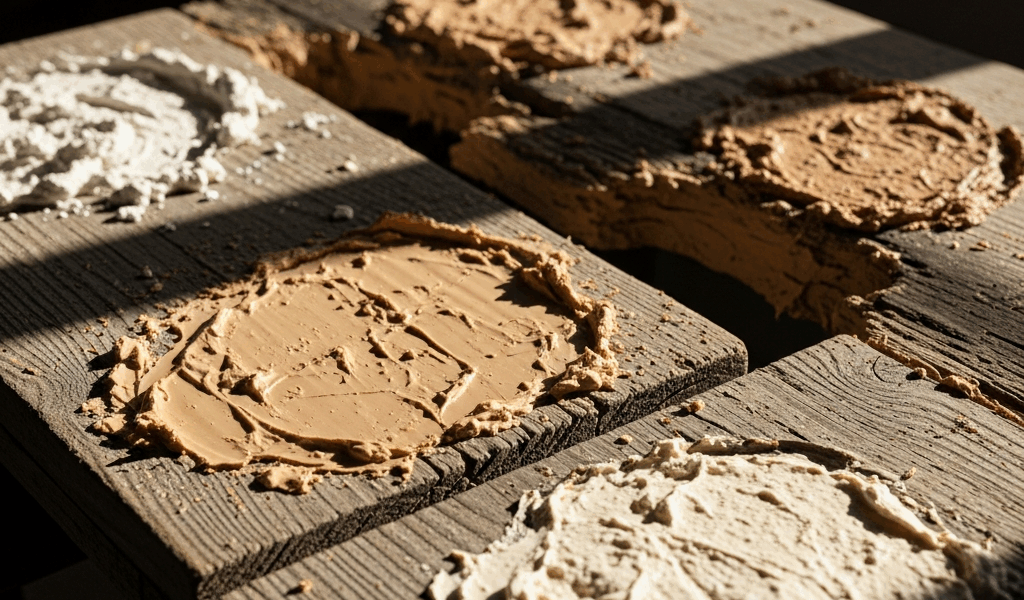
Why Wood Filler Shrinks in the First Place
Wood filler shrinking after drying is one of those frustrations that hits right when you think your project is finished. You fill a gap, sand it smooth, apply stain—and three weeks later, a thin valley appears exactly where you’d filled. Water and binder loss. That’s the culprit.
Most wood fillers are suspensions — meaning solid particles like sawdust, wood fibers, or mineral powder suspended in a liquid binder. Water-based fillers contain water. Oil-based fillers contain mineral spirits or linseed oil. Epoxy fillers contain resin. As that liquid evaporates or chemically converts during curing, the particles settle closer together. It’s exactly like wet concrete shrinking as it hardens — the water leaves, and the solid mass compacts. The deeper your fill, the more water has to leave from the center, and the more dramatic the shrinkage becomes.
Binder breakdown matters too. Some fillers rely on water evaporation alone. Others cure chemically, meaning the binder itself transforms into a solid state through polymerization or oxidation. During that transformation, molecules rearrange and compress, pulling the entire mass inward.
Then there’s particle size and density. Fine, tightly packed particles shrink more noticeably than coarse, loose ones — because there’s less air space between particles to absorb the volume loss. That’s why some premium fillers don’t shrink as badly as hardware-store alternatives.
Shrinkage Rates by Filler Type
Probably should have opened with this section, honestly. Different fillers behave like completely different materials, and knowing which shrinks how much is half the battle.
Water-Based Fillers
Water-based fillers — think DAP Fast ‘N Final or Elmer’s Carpenter’s Wood Filler — typically shrink 10–15% by volume as they dry. That’s significant. A quarter-inch fill shrinks visibly. The reason? Water makes up 40–60% of the product by weight. All that water has to go somewhere, and it goes into the air. The binder is usually latex or acrylic and it’s already solid, so it just compresses as the water leaves.
Where they fail: Deep fills on vertical surfaces. The top dries faster than the bottom, creating uneven shrinkage and cracking. They also don’t sand perfectly uniform after drying, because some fillers stay slightly flexible.
Where they win: Speed, low odor, cleanup with water, and the ability to accept wood stain without sealing first. I’ve had good success with DAP on pine trim repairs where the gap was under 1/8 inch. Worked great every time.
Oil-Based Fillers
Oil-based fillers like Minwax Stainable Wood Filler or generic hardware-store paste shrink 8–12%. Less water means less evaporative loss, but the oil-resin binder still oxidizes and hardens, compacting slightly. They cure slower — typically 24 hours or longer — which actually reduces stress cracking because shrinkage happens gradually.
The trade-off: They cure slowly, they smell strong, and mineral spirits disposal is a mild environmental headache. They also bleed through water-based stains if you don’t prime or seal first.
Where they excel: Quarter-round and baseboards on hardwood floors. The slow cure prevents the hairline cracks you’d get from fast-drying water fillers.
Epoxy Fillers
Two-part epoxy — Bondo Wood Filler, West System, or professional-grade epoxies — shrinks 2–5% because epoxies cure through chemical polymerization, not evaporation. Molecules cross-link into a rigid network. Minimal volume loss because no significant liquid is leaving the system. However, some epoxies generate heat during cure, which can cause micro-cracking if the fill is too thick and cures too fast.
The catch: They’re expensive — $12–$25 per pint versus $3–$8 for water-based. They require exact mixing ratios, set quickly, and sand like plastic — sometimes too hard to sand smoothly without a power sander. They also don’t absorb stain the same way wood does, so you need special epoxy stains or dyes.
When to use them: High-visibility repairs on expensive hardwoods, or situations where wood movement is expected and you need zero shrinkage. I’ve used Bondo on a walnut vanity where even 2% shrinkage would’ve been visible through the finish, and it was worth the extra effort.
Grain-Matching Fillers
Products like Zinsser DryDex or Mohawk Scrapers don’t really avoid shrinkage — they just minimize visibility through grain texture and color matching. Shrinkage is still 10–12%. These are confidence fillers, not magic fillers.
Application Techniques That Reduce Shrinkage
Here’s where most DIY woodworkers go wrong. They apply filler once, deep, and wonder why it craters. The real solution is a layering strategy.
The Fill-Depth Rule
Never fill more than 1/4 inch deep in a single application with water-based fillers. Epoxy can handle up to 1/2 inch. Anything deeper, and the center takes forever to cure while the surface dries and shrinks, creating internal stress and visible depression.
For gaps wider than 1/4 inch, use two or three thin coats. Let each coat cure fully — check the label, it’s usually 1–3 hours for water-based, 24 hours for oil. Sand lightly between coats with 120-grit paper. Just enough to remove dust and give tooth for the next layer. The second coat shrinks less because there’s already a solid base underneath, reducing absolute volume loss.
Moisture Control During Curing
Humidity matters. Fillers cure slower in high humidity because evaporation is slower. Sounds bad, but it’s actually good — slower cure means less stress and fewer cracks. If you’re working in a heated, dry house in winter, use a damp cloth to cover the repair for the first 2–3 hours. This slows surface evaporation and encourages more even curing.
Don’t cure fillers in direct sunlight. Temperature swings cause differential shrinkage between the surface and interior.
Overfill Deliberately
Apply filler slightly proud — about 1/16 to 1/8 inch above the surrounding wood. This compensates for shrinkage. Sand it flush after curing. Yes, you’ll sand away some filler, but you’ll hit the wood surface at the right depth.
Press It Down
Force the filler into the gap. Use a putty knife to press hard, multiple times. This removes air pockets and increases density, which reduces both shrinkage and cracking. Air-filled filler shrinks more than tightly packed filler because the particles have room to rearrange.
Fixing Shrinkage After It Happens
Sometimes you catch shrinkage too late. The stain is already on. The topcoat is drying. What now?
Minor Gaps (Hairline to 1/16 Inch)
Sand the area smooth and apply a grain-matching stain marker or touch-up pen directly into the gap. Minwax stain markers work well here. It won’t disappear completely, but it’ll blend into the wood grain pattern, and under normal light, it’s invisible. This takes 5 minutes and costs $4.
Visible Valleys (1/16 to 1/8 Inch)
Sand the area with 120-grit paper to remove any hardened stain or finish. Clean the dust. Re-fill with the same filler type — now you know which one. Use the overfill method. Let it cure fully. Sand and stain to match. This is a 30-minute fix and works well if you caught the shrinkage within a week of the original fill.
If the topcoat is already on, scrape carefully with a card scraper to remove finish from the sunken area only, exposing bare wood. Then re-fill and restain. This sounds tedious, but it’s often faster than sanding the entire surface back.
Accepting Minor Imperfections
Honest moment: if the hairline gap is in the back of a cabinet or under a table, fill it once and leave it. The psychological cost of perfection isn’t worth two hours of rework. I’ve learned this the hard way on projects where I’ve spent more time on invisible repairs than on the visible parts. Minor gaps don’t affect structural integrity, and wood naturally moves and shifts anyway.
Pro Tip: Test Your Filler First
Before committing to your project, grab a scrap of the same wood species you’re working with. Drill or cut a 1/4-inch gap. Fill it with the exact filler and application method you plan to use. Let it cure in the same room, same humidity, same temperature as your project will sit. Inspect it daily for the first week. Measure the shrinkage. Sand and stain it. This costs 15 minutes and prevents surprise gaps on the finished piece.
If you’re alternating between filler types — say, water-based for quick trim work and epoxy for fine furniture — test both. You’ll quickly see which one shrinks unacceptably in your environment. This simple step has saved me from redoing entire projects.



Stay in the loop
Get the latest the workshop journal updates delivered to your inbox.