Miter Saw Setup and Calibration — Get Perfect Cuts Every Time
Miter saw calibration has turned into a moving target with all the conflicting advice flying around — half of it written by people who’ve clearly never fit a mitered door frame at the end of a long day. As someone who’s been running a small custom millwork shop for eleven years, I got hands-on with what happens when you skip this stuff. The short version: trim that doesn’t fit, gaps you end up stuffing with painter’s tape, and that specific feeling of hoping nobody looks too closely at the corners. I still calibrate my Dewalt DWS779 before any project where tolerances actually matter. Not because I don’t trust the saw — it’s a good saw — but because saws drift. They get bumped, moved, dropped by guys who swear on their lives they didn’t drop anything. Suddenly your 45-degree cuts are producing gaps wide enough to slide a business card through. This guide walks every calibration check in the order that makes mechanical sense, with real measurement methods and tolerances you can actually hit in a working shop.
The Five Calibration Checks — In Order
The sequence matters here. You can’t meaningfully calibrate a bevel angle when the blade still isn’t square to the fence. Each check builds on the last — skipping around wastes time and gives you results you can’t trust.
Here’s the order, and why it works:
- Blade square to fence — establishes your lateral reference plane
- Blade square to table — establishes your vertical reference plane (bevel zero)
- Fence alignment — confirms the fence is straight and coplanar with itself
- Miter angle accuracy — tests the detent positions against a known square reference
- Bevel angle accuracy — tests bevel detents once the blade-to-table relationship is confirmed
The whole process runs about twenty-five minutes once you’ve done it a few times. First time through, give yourself an hour. You’ll need a reliable combination square, a quality framing square, and a decent digital angle gauge — I use a Wixey WR300, picked it up for around $40, and it’s earned its spot in the bag many times over. Don’t cheap out on the gauge. A bad one will lie to you with tremendous confidence.
Blade to Fence — The Most Important Check
This is the piece to know up front, because this single check catches more problems than anything else on this list. When the blade isn’t perfectly perpendicular to the fence, every crosscut is wrong. Not dramatically wrong, necessarily — but consistently, accumulatively wrong in a way that shows up ugly when you’re fitting mitered frames or running long sections of baseboard around a room.
How to Measure Properly
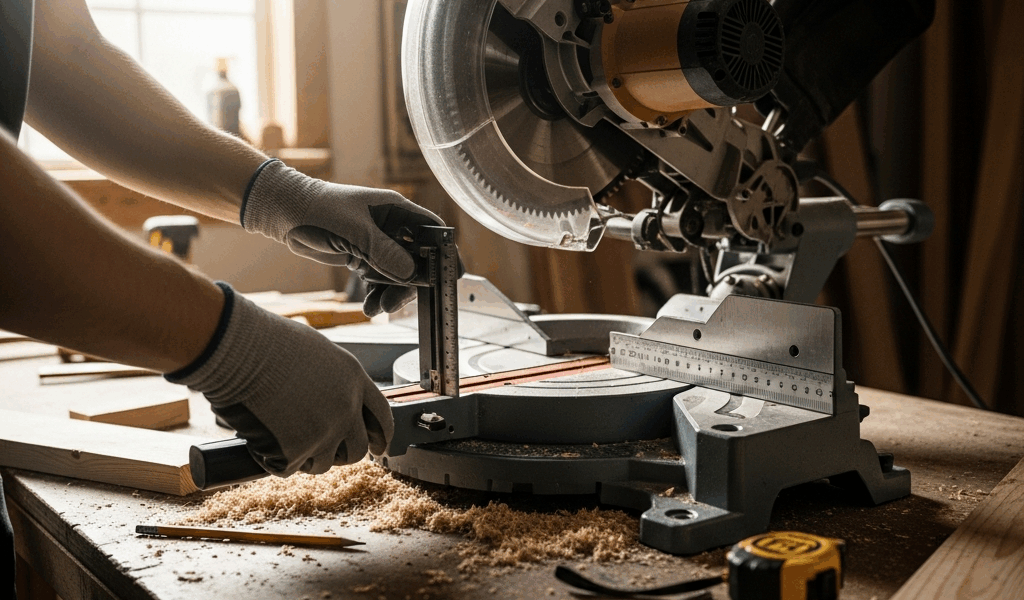
Lower the blade to roughly two inches above the table surface. Here’s the part people get wrong: don’t put your combination square against the teeth. Put it against the flat body of the blade. Carbide teeth splay outward slightly by design — measuring against them introduces error before you’ve even taken a real reading. Place the square’s body flush against the fence, then slide the rule out until it makes contact with the blade flat.
Your target is within 1/64 of an inch — that’s 0.015 inches. At that tolerance, a 45-degree miter across a five-inch piece of baseboard produces a gap smaller than a hair’s width. That’s acceptable. Past that, you’re in shim-and-pray territory.
Adjusting the Fence
Most sliding fences on compound miter saws have two or three adjustment bolts behind the fence body. Loosen them slightly — not all the way out — then use a dead-blow mallet to tap the fence into position while your square is still in contact with the blade. Snug the bolts back down and recheck. It almost always moves a little during tightening, so check twice before you call it done.
Side-step the error I made. On my old Ridgid R4120, I fully loosened one bolt before touching the others. The fence pivoted out of square in a completely different direction — I spent forty minutes chasing my tail around that shop before I figured out what happened. Loosen all adjustment bolts the same small amount, simultaneously. Small adjustments. Recheck every single time.
Blade to Table — Fixing Bevel Zero
The blade should be perfectly vertical — ninety degrees to the table — when the bevel reads zero. That’s your bevel zero stop, and it’s controlled by a small set screw on the bevel mechanism. On most saws, it’s accessible from the front or side of the pivot housing — check your manual for the exact spot. On the DWS779, it’s tucked behind a small rubber plug on the left side of the bevel pivot. Took me longer to find than I’d like to admit.
Taking the Measurement
Set the saw to zero bevel, lock it down, and place your combination square flat on the table with the rule running up the face of the blade body. You’re looking for full contact along the entire length of the rule. Any daylight at the top or bottom tells you the blade is tilted. The Wixey gauge also works well here — stick it to the blade body with the magnet and read the angle directly. You want 90.0 degrees. Not 90.2. Not 89.8.
Adjusting the Stop Screw
Find the bevel zero stop screw and turn it in small increments — usually an eighth of a turn produces a meaningful change. Tilt the saw slightly past zero, then bring it back and let it settle against the stop. Check the angle again. Repeat until it reads true. Always approach the stop from the same direction when testing — mechanical stops have a small amount of play, and you want the blade resting consistently against the stop every time, not floating between approaches.
After dialing in the stop, make a test cut in scrap. Two cuts from opposite ends of a board, face down, then mate the cut surfaces together. If they form a flat plane with no rocking, bevel zero is correct. If there’s a gap at the top or bottom of the joint, you’ve got a few more hundredths of a degree to chase down.
Miter Angle Calibration
Here’s where the forty-five degree test comes in — and it’s more reliable than trusting the saw’s built-in angle indicator. The indicator on most saws, even good ones, is accurate to about half a degree. That’s not good enough for picture frames or cabinet face frames where four 45-degree cuts need to produce a perfect rectangle.
The Forty-Five Degree Test Method
Cut two pieces of scrap at forty-five degrees from opposite directions — miter left and miter right, same angle setting on each. Stand the cut ends together on a flat surface and check the resulting corner with a reliable square. The corner should be exactly ninety degrees. If it reads eighty-nine degrees, your detent is sitting about half a degree off. Ninety-one degrees — same problem, other direction.
Why two cuts instead of one? Because a single cut only tells you the blade is at forty-four or forty-six degrees relative to something. Two matching cuts at the same setting amplify any error into the corner angle, making it far easier to detect. Divide by two and you’ve got the error per cut.
Adjusting the Miter Detents
Most modern saws have micro-adjust capability on the common detents — zero, fifteen, twenty-two-point-five, thirty, and forty-five degrees. The adjustment is usually a small screw that changes where the detent ball seats. That’s what makes detent adjustment endearing to us finish carpenters — tiny screw, massive practical difference.
Frustrated by a persistent gap in a cabinet door frame he’d cut three times on a Monday morning, a cabinetmaker I know spent an afternoon remeasuring and found his saw’s forty-five-degree detent was consistently landing at forty-four-point-six degrees — confirmed with a known-good digital protractor. He turned the detent screw barely a quarter turn. Problem gone. The saw had apparently been like that since he bought it — he just hadn’t tested it properly at setup.
Small adjustment, huge impact. Check the detents. Don’t assume the factory got it right, because often they didn’t.
Bevel Angle Accuracy
Once blade-to-table is confirmed, checking the bevel angle detents follows exactly the same logic as miter angle work. The most critical bevel position is forty-five degrees — that’s where compound miter work on crown molding lives or dies. Use your digital angle gauge stuck directly to the blade body. Don’t trust the bevel scale printed on the saw housing. Those scales are reference points, not precision instruments — there’s a meaningful difference.
Set the bevel to forty-five, lock it, and read the gauge. Adjust the bevel stop screw until the reading is consistent and accurate. Then make a test cut — same paired forty-five-degree method, two cuts from opposite bevel directions, mated together, checked against a known square reference.
Ongoing Maintenance — Keep It Accurate
Calibration isn’t a one-time event. Here’s what actually keeps a saw accurate across months of real shop use.
Clean the Table and Fence Regularly
Sawdust compresses. A layer of fine dust packed against the fence face introduces a consistent tilt to every piece you cut against it — and it’s invisible until you’re already three cuts into expensive stock. I wipe down the table and fence with a dry rag before any precision work. Takes ninety seconds. Costs nothing. I’ve personally watched guys spend an hour recalibrating a saw that just needed a wipe-down. Don’t be those guys.
Check Alignment After Moving the Saw
Every time the saw moves — off the stand, into a truck, across the shop floor — run the blade-to-fence check before cutting anything that matters. The DWS779 weighs around 56 pounds. That’s enough mass that even setting it down firmly on the stand can shift the fence a few thousandths. Quick check, two minutes, saves you from discovering the problem at cut thirty instead of cut one.
Blade Change Procedure That Preserves Calibration
When you swap blades, check blade-to-table and blade-to-fence afterward. Not because the blade change itself moves the fence, but because it’s a natural checkpoint — and some blades run slightly out of flat from the factory. Not common on quality blades, but it happens. Check the new blade the same way you checked calibration originally: square against the blade body, not the teeth.
Use the same torque on the blade bolt every time. Overtightening can very slightly distort the blade washer seating — introduces a tiny wobble that shows up as roughness in cuts and makes precise measurement harder. Hand-tight plus a firm quarter turn with the wrench is plenty on almost every saw I’ve used.
Keep a small notebook near the saw — a $2 composition book works fine, I’ve got one tucked to the side of my stand right now — and date each calibration check. Write down what you adjusted and by how much. After a few months, you’ll start seeing patterns. Some saws drift in one direction consistently. Knowing your saw tends to go a quarter degree off on the forty-five-degree miter detent every six weeks tells you exactly where to look first when something starts cutting slightly wrong. That’s not guesswork anymore. That’s an actual maintenance system.


Stay in the loop
Get the latest the workshop journal updates delivered to your inbox.