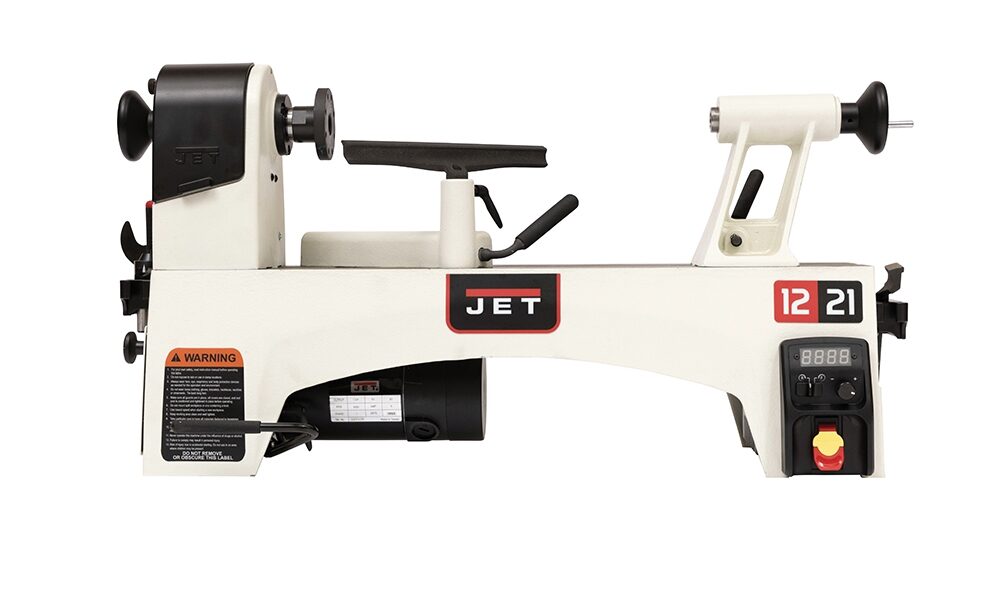
Turning is intimate work. You stand in one spot for hours, your hands inches from spinning wood, your eyes fixed on the evolving form. Get the lathe position wrong and you’ll fight fatigue, struggle to see your work, and breathe sawdust all day. Get it right and turning becomes the meditative, satisfying craft it should be.

Height: The Non-Negotiable Measurement
The lathe spindle centerline should be at your elbow height. Period. This isn’t a suggestion. It’s ergonomics backed by decades of professional turning experience.
Stand relaxed with your arms at your sides. Bend your elbow 90 degrees. That’s your spindle centerline height. For most people, this falls between 38 and 44 inches from the floor.
Too low and you’ll hunch over the work, destroying your back within a year. Too high and you lose control, fighting the tool instead of guiding it. The elbow-height rule applies regardless of whether you’re turning bowls, spindles, or hollow forms.
Most lathes ship with fixed-height legs designed for the “average” person. If you’re not average, modify the legs or build a custom stand. Adjustable-height lathe stands exist but add complexity. A fixed stand at your optimal height is simpler and more rigid.
Lighting That Actually Helps
Overhead shop lighting casts shadows on the workpiece. Those shadows hide tearout, catch lines, and surface defects until after you’ve applied finish. That’s too late.
Install a dedicated articulating light positioned to illuminate the cutting zone directly. LED work lights with adjustable color temperature work well. Position the light so it shines on the workpiece from your line of sight, eliminating shadows created by your body or the lathe components.
Some turners use two lights: one from each side of the work area. This eliminates shadows entirely and reveals every surface flaw instantly. The investment is under $100 for quality LED fixtures.
Avoid fluorescent lighting at the lathe. The flicker can create stroboscopic effects with spinning work that hide actual RPM and surface conditions. LED or incandescent only.
Chip Collection Strategy
Lathes create three types of debris: long stringy shavings, short chips, and fine dust. Each requires different handling.
Long shavings don’t travel through dust collection effectively. They clog ports and hang up in transitions. Let them fall to the floor and sweep up periodically, or position a collection bin below the headstock and tailstock to catch them.
Short chips and dust do travel through collection systems. A 4-inch port positioned behind and below the spindle centerline captures the majority of airborne particles. Mount the port to the wall or ceiling behind the lathe, not to the lathe itself, as the lathe vibration loosens connections over time.
An ambient air cleaner hanging above the lathe addresses the fine dust that escapes your collection system. Run it constantly when turning, especially with exotic hardwoods and spalted material.
Floor Space and Access
You need clear floor space for your turning stance. Plan for 4 feet of clearance on the operator’s side of the lathe. This allows you to shift position along the bed for different operations and provides room for your tool rest and grinding station.
On the headstock outboard side, leave 3 feet minimum for faceplate work. Large bowls and platters swing past the bed, and you need access for mounting and removing work.
Behind the lathe, 2 feet of clearance provides access for maintenance and banjo adjustment. Many turners position the lathe on a wall but leave enough gap for a person to slide through.
The Grinder Station
You’ll sharpen frequently during turning. The grinder should be within three steps of your turning position, preferably visible from the lathe. Most turners position it slightly behind and to one side of the lathe so they can step back, sharpen, and return without losing their visual reference of the workpiece.
Mount the grinder at a height that matches comfortable sharpening posture. This is typically 4-6 inches higher than the lathe spindle centerline.
Put It All Together
The ideal lathe position: spindle at elbow height, dedicated lighting from the front, chip collection behind, grinder within steps, and clear floor space all around. Get these fundamentals right and your turning sessions become comfortable, productive, and safe. Skip any of them and you’ll know it within the first hour of serious work.
\n\n
Related Articles
\n


Stay in the loop
Get the latest the workshop journal updates delivered to your inbox.