Compressed air systems have gotten installed as afterthoughts in most home shops — whatever compressor fit the corner, whatever hose reached the work area. As someone who ran an undersized, poorly plumbed system for years before finally building a proper one, I can tell you the difference is significant. Today I’ll cover what you actually need and how to set it up right.
Compressed air powers nailers, sprayers, blow guns, and specialized tools that have no electric equivalent. Proper sizing and professional-grade plumbing transform compressed air from an annoyance into a reliable utility.
Understanding CFM Requirements
Air tools are rated by CFM (cubic feet per minute) at a specific pressure, typically 90 PSI. This is consumption rate, not peak demand. A framing nailer might need 2.2 CFM at 90 PSI. An HVLP spray gun might need 8-15 CFM at 40 PSI. A die grinder can consume 6-9 CFM continuously.
Add up the CFM requirements for tools you’ll run simultaneously. Usually this means one or two tools at most, but spray finishing while running a nailer or sander happens. The compressor must supply that combined demand plus a margin for pressure recovery.
Rule of thumb: size your compressor for 1.5 times your maximum expected simultaneous demand. If your spray gun needs 12 CFM and you might run a blow gun while spraying, you need at least 20 CFM of compressor capacity. I’m apparently someone who sized for the average instead of the peak and spent years compensating with compressor wait time.
Tank Size and Duty Cycle
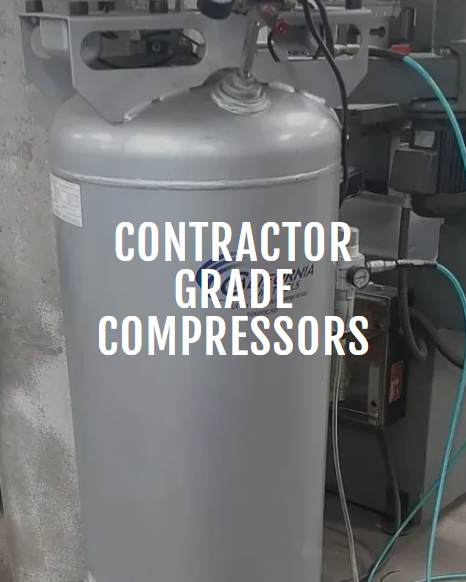
Tank size affects how long you can run before the compressor cycles on. Large tanks provide more reserve for peak demands and reduce cycling frequency. For shop use, 60-80 gallons is the sweet spot. Smaller tanks work for occasional nailer use but struggle with continuous-demand tools like sprayers.
Duty cycle matters for production work. Consumer compressors have 50% duty cycles, running 30 minutes out of every hour maximum. Commercial units designed for shop use offer 75-100% duty cycles. If you’re running air tools for hours at a time, duty cycle determines whether the compressor keeps up or overheats.
The Plumbing System
Rubber hose from the compressor to the tool works but it’s inefficient, collects condensation, and gets in the way. A permanent shop air system uses rigid pipe as the main distribution with drops to work areas.
Pipe Options:
Black iron pipe is traditional, inexpensive, and effective. It rusts internally over time, potentially contaminating air lines with scale. Use it if budget is tight and you’ll install proper filtration downstream.
Copper pipe doesn’t rust and provides excellent flow characteristics. More expensive and requires soldering or compression fittings. Worth the investment for a permanent system where you want zero maintenance worries.
Aluminum modular systems — RapidAir, Infinity, and similar — snap together without threading or welding. They don’t rust, modification is simple, and components are available at home centers. Cost falls between iron and copper. Excellent choice for DIY installation. Probably should have started with this option rather than cobbling together a black iron system first.
PVC is tempting but dangerous. Standard PVC becomes brittle under pressure and can shatter explosively, sending shrapnel through the shop. Some specialty pressure-rated PVC exists, but most codes prohibit PVC for compressed air. Just avoid it.
System Layout
Run the main trunk around the shop perimeter as a loop. This eliminates dead ends and equalizes pressure throughout the system. The compressor feeds the loop at one point, and every location draws from two directions simultaneously.
Size the main line for minimal pressure drop. 3/4-inch pipe handles most home shops. 1-inch provides headroom for expansion and high-demand tools. Dropping to 1/2 or 3/8 inch for final short runs to outlets is fine.
Slope all horizontal runs slightly toward a drain point. Condensation forms continuously and must go somewhere. A low point with a petcock valve collects water for regular draining.
Drops and Outlets
Run drops from the top of the main line, not the bottom. This prevents accumulated water from running down into your tools. The drop runs down to a filter/regulator/lubricator (FRL) unit, then to a quick-connect outlet.
Position outlets at each major work station. Think about where you actually use air tools: near the finishing area for spraying, at the bench for nailers and blow guns, at the assembly table, near the dust collector for blow-out.
Install FRL units at each major outlet. The filter removes condensation and particulates. The regulator sets appropriate pressure for each tool. The lubricator adds oil for air-powered tools that need it. Keep the lubricator bypassed for spraying and blow guns that don’t tolerate oil contamination.
Maintenance Items
Drain the tank daily. Moisture accumulates inside and promotes rust. An automatic drain valve eliminates the manual chore entirely and is worth the small investment.
Replace filter elements quarterly or when pressure drop across the filter exceeds 2-3 PSI. Dirty filters starve tools and waste compressor energy.
Check for leaks annually using soapy water at joints. Even small leaks waste significant energy and reduce available pressure. A leak test with the compressor off reveals how fast pressure drops, indicating overall system integrity.
Proper compressed air infrastructure runs silently in the background, delivering clean, dry, consistent pressure wherever you need it. Build it right once and it serves reliably for years.