Why Your Jointer Leaves a Curved or Tapered Edge
Jointer troubleshooting has shifted noticeably with all the conflicting advice flying around. You feed a warped board in, expecting flat reference surfaces on the other side, and what you get instead is a tapered edge, snipe marks, or a bow that never left. The machine looks fine. Tables seem level. Nothing’s obviously wrong — and that’s exactly what makes it so maddening.
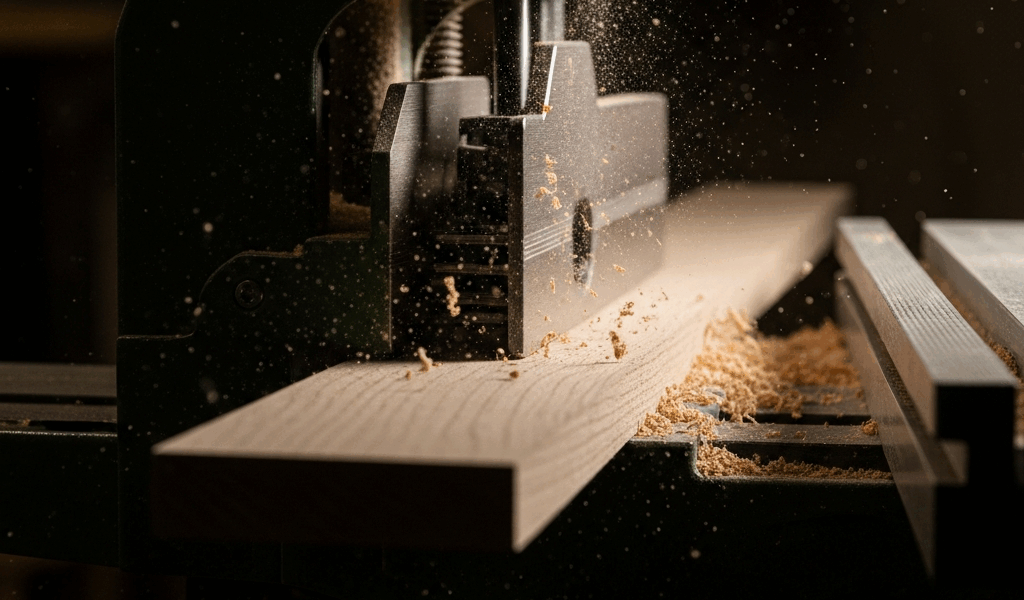
Here’s the mechanical reality most people skip over. A jointer flattens by pulling material across a spinning cutterhead while the outfeed table acts as your flat reference plane. The board leaves the infeed table, contacts the knives, and lands on the outfeed table at the exact height where those knives peak. If that outfeed table is even slightly off, the board never gets supported correctly. It exits the machine just as wrong as it entered — maybe worse.
Three root causes account for nearly every jointer failure I’ve diagnosed — in my own shop and in other people’s. Outfeed table height. Dull or uneven knives. Incorrect feed technique. I’ll walk through each one in order. Fix the right problem first instead of guessing your way through $200 worth of replacement knives.
Check Outfeed Table Height First — It Is the Likely Culprit
The outfeed table must sit exactly level with the highest point of the cutterhead arc. We’re talking 1/32 inch of error producing visible, repeatable problems. Too low and you get snipe at the board’s trailing end. Too high and the board bows upward as it exits. Both failures look identical from across the shop — and both get blamed on everything except the actual cause.
This is the piece to know up front. I spent two full days honing knives and obsessing over feed pressure before I checked table alignment on my old 8-inch Delta jointer. The outfeed was sitting 3/64 inch high. That’s it. That was the whole problem.
Test this with a straightedge and a feeler gauge. Lay the straightedge flat across both tables, perpendicular to the cutterhead. Positioned directly over the knives, it should rock slightly — that gap is the cutterhead arc. Measure it. Then measure the gap between the straightedge and the outfeed table surface at the leading edge. Those two numbers need to match. If the outfeed reads higher, your machine is actively creating snipe every single pass.
Adjustment varies by machine, but most jointers use mounting bolts or gib screws around the outfeed table base. Loosen them slightly — not completely — and tap the table edge with a brass mallet until the straightedge test passes. Check front and back both. A twisted outfeed is actually worse than a slightly low one, because it affects different parts of the board inconsistently. Tighten the bolts in a cross pattern — same as car wheel lugs — so the table doesn’t shift during final tightening.
Dull or Uneven Knives Cause More Problems Than Most Realize
But what are dull knives actually doing to your boards? In essence, they’re burnishing rather than cutting — crushing wood fibers instead of slicing them. But it’s much more than that. The surface looks almost flat until you try to glue it up, and then the joint fails because there’s nothing for the adhesive to grip. Glazed fibers don’t hold glue. The board looked fine. The joint didn’t.
Uneven knife height is a separate problem entirely. If your three knives don’t all peak at the same height — even by a few thousandths — you get a washboard pattern across the face. Dozens of alternating ridges per inch. You can feel it immediately with your palm. It looks like someone dragged a comb through wet paint.
Here’s the quick diagnostic I use: mark a line across the cutterhead with a Sharpie, rotate the head by hand, and watch whether the mark transfers consistently to a board held lightly against the knives. If it skips one rotation, at least one knife is low. You’ll need to pull the cutterhead and use a marking gauge to find which one specifically. This is why knife setting is genuinely its own skill — and why a lot of serious woodworkers either buy pre-set spiral heads or send their machines out for professional setup once a year.
Honing versus replacement comes down to what you’re actually working with. If the knives are still 3/16 inch thick and just need an edge refreshed, honing makes sense. Most modern 4-square knives give you multiple usable edges before you’re done with them. But if they’re chipped or already worn down to 1/8 inch, replace them. New blades for a mid-size jointer run $40 to $80 depending on the machine — a Powermatic 54HH takes around $65 for a full set right now. The time saved on fussing with a bad edge is worth it every time.
Feed Technique and Board Camber Are Sneaky Causes
I’m apparently a pressure-hog at the infeed side, and consciously shifting that pressure mid-pass works for me while my old habits never did. Skip past the mistake I made. Pressing hard on the infeed defeats the entire point of the outfeed table. You’re forcing the board into the knives at your preferred angle — and when the board clears the cutterhead and should be resting on the outfeed reference surface, you’ve already introduced your own error.
The correct motion is hands on infeed with light downward pressure, then a deliberate shift toward the outfeed side as the board passes the cutterhead. Reduce that downward force as you transition. The outfeed table — not your palms — becomes the reference. Most people learn this by muscle memory after a dozen boards. It doesn’t click from description alone. You have to feel the board settle onto the outfeed and stop fighting it.
Board camber complicates everything further. A severely cupped or bowed board needs multiple passes, and starting face matters. Place the board concave-side down on the infeed table — that’s the stable orientation. The jointer removes high spots. After one pass, flip and repeat on the opposite face. Most face jointing on genuinely warped stock requires 3 to 5 passes on a typical 8-inch jointer before you have a true reference surface. On dense hardwoods like white oak or hard maple, expect 1/32 to 1/16 inch of material removal per pass at normal feed speed on a 4 or 5 horsepower machine. A severely warped board can disappear before it flattens. That’s not an exaggeration.
When the Jointer Still Will Not Flatten — What to Check Next
Verified table height. Sharpened knives. Fixed your technique. Board still exits tapered. At this point, something mechanical is broken — and broken differently than the usual suspects.
Start with the fence. An out-of-square fence affects face jointing results even when edge jointing seems fine. Check it with a machinist’s square held against both the fence face and table surface at several points along its length. A Starrett 12-inch combination square works well for this. Small discrepancies add up over a long board.
Cast iron tables develop wear. Gibs — the adjustable support pieces beneath the tables — loosen over years of use, and tables flex slightly during cutting. That flex introduces inconsistency that no amount of technique fixes. The winding sticks test catches this: place two thin straight boards parallel across both jointer tables and sight across them from one end. If they don’t align, your tables aren’t coplanar. That’s a structural problem, not an operator problem.
That’s what makes this particular failure so frustrating to diagnose — it mimics every other problem until you do the winding sticks check.
At that point, the jointer needs professional attention. Rebuilding table support or replacing worn gibs requires precision equipment and trained hands. A complete professional tuning on a mid-size jointer runs $200 to $400 depending on your market, but it brings the machine back to original factory accuracy. Sometimes that’s the right answer instead of fighting a machine that’s genuinely past what adjustment can fix.
So, without further ado — start with outfeed table height. Verify knife sharpness second. Dial in feed technique third. Most boards flatten cleanly once you’ve worked through that sequence in order, without skipping ahead.

Stay in the loop
Get the latest the workshop journal updates delivered to your inbox.