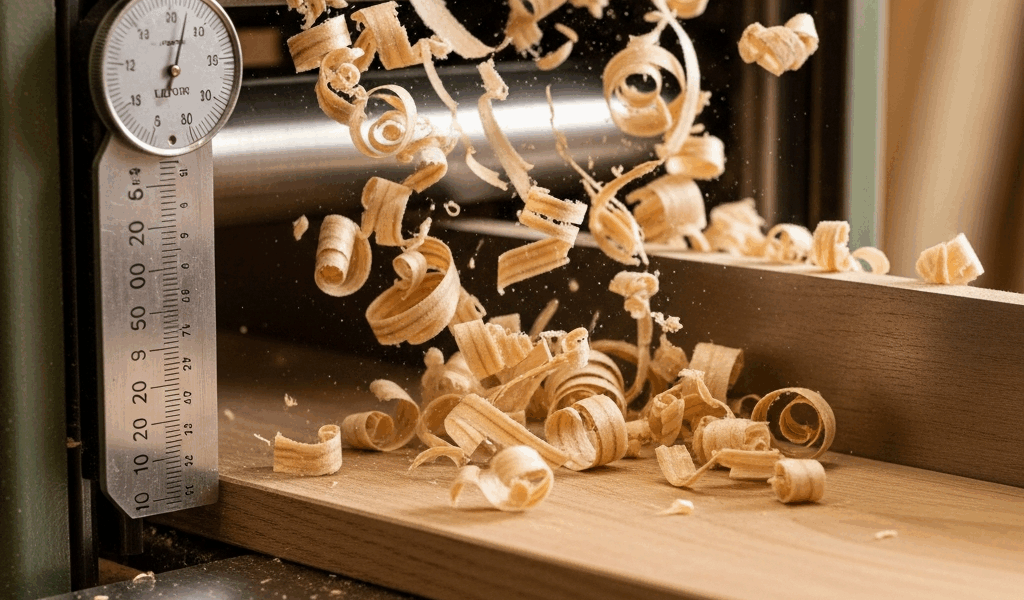
What’s Actually Happening When Snipe Occurs
Planer snipe has gotten less clear-cut with all the conflicting advice flying around. Forums blame the machine. YouTube comments blame technique. The truth is simpler — and more fixable — than either camp suggests.
Those gouges at the leading and trailing edges of your board come down to one mechanical reality: uneven downward pressure during the cut. When your board enters the planer, the infeed roller holds it down. When it exits, the outfeed roller takes over. In between those two contact points? The board rides on the bed alone. Nothing pressing down at the ends.
The cutterhead doesn’t care. It spins at the same depth regardless. So when your board tips even slightly upward at the front or back edge — even a hair — the cutterhead takes a deeper bite. You get a scoop. Understanding this mechanical truth changes everything about how you fix it. It’s pressure imbalance, not operator error, not a defective machine.
The Three Things Most Likely Causing Your Snipe
Misaligned Infeed and Outfeed Tables
This is the most common culprit I’ve seen across benchtop and mid-range machines — and the one people check last for some reason. Your infeed table, outfeed table, and planer bed need to sit at exactly the same height. If the outfeed table sags even 1/32 of an inch below the bed, the board drops as it exits. The cutterhead catches the trailing edge. Same story on the infeed side, just mirrored at the front of your board. Grab a long straightedge and lay it across all three surfaces. That’s your diagnostic right there.
Roller Pressure Set Incorrectly
Too light, and the board bounces under the cutterhead. Too heavy, and you’re forcing the board upward — which creates that same tipping motion at the edges. Most machines have adjustment bolts or a pressure knob somewhere. If yours does, it’s rarely set correctly out of the box. Avoid the path I took of assuming the factory got it right. The rollers should grip firmly enough to prevent drift but not so hard that feeding the board by hand takes real effort.
No Support at the Board’s Ends
Honestly, this is probably the fastest fix available. It’s also the one most hobbyists skip entirely. If you’re not supporting your board at bed height as it feeds through, gravity and momentum handle the rest. The board flexes. The edges dip. The cutterhead finds them. That’s what makes this problem so endearing to us woodworkers — the fix is sometimes just standing in the right place.
How to Reduce Snipe Before You Even Start the Cut
Before you touch a wrench or adjustment dial, change how you feed your stock. This alone stops most snipe without any machine tweaking. So, without further ado, let’s dive in.
- Use sacrificial scrap boards. Run a cheap piece of pine or poplar through the planer just ahead of your good board. Follow up with another scrap behind it. The rollers stay under pressure from first contact to last. Your workpiece rides stable in the middle of that sequence. You burn through some scrap. You keep your good hardwood intact.
- Hand-support long boards on both ends. Position yourself at the infeed side with one hand under the board at bed height — not pushing, just keeping it level as the rollers pull it through. Have a second person handle the outfeed side, or position yourself to move quickly. This is standard practice in cabinet shops handling premium figured maple or walnut. There’s a reason for that.
- Never force the board. Let the rollers do the work. If you’re pushing hard, something is wrong — either the depth of cut is too aggressive or the roller pressure needs adjusting. A properly set planer pulls the board through with barely any hand pressure at all. You’re basically just guiding it.
I’m apparently someone who runs sacrificial scrap religiously now, and my DeWalt 734 works for me while aggressive single-board passes never did. The machine hasn’t changed. The workflow did. That difference is worth more than any mechanical adjustment I’ve made.
Adjusting Your Planer to Minimize Snipe
If feed discipline doesn’t solve it, the machine itself needs attention. Start here.
Check Table Alignment First
Grab a straightedge at least 36 inches long. A level works in a pinch, though a machinist’s straightedge is better — the $25 kind from Amazon is fine. Lay it across the infeed table. Shift it to span the bed. Move it to the outfeed table. Look for gaps underneath. Even a gap you can barely see matters at planer tolerances. If the outfeed table sits low, you’ll need to shim it or adjust the mounting bolts. Most benchtop planers have limited adjustment here, but it’s worth checking before you chase anything else.
Adjust Roller Pressure if Your Machine Allows It
Cabinet planers and some mid-range models have bolts or levers for changing infeed and outfeed roller pressure. Benchtop machines — the Wen 6552, the DeWalt 734 — don’t have that. Fixed pressure curve by design. If your machine does allow adjustment, back the pressure off slightly, run a test cut on scrap, and tighten only if the board starts slipping. You want the lightest grip that still pulls the board smoothly and consistently.
Know Your Machine’s Limits
Quick callout up front. A $300 benchtop planer will never perform like a $3,000 cabinet model. That’s not a failure on your part. Accept the machine’s envelope and work inside it. Multiple lighter passes instead of one heavy cut reduce snipe on their own — less force, less board deflection. Simple physics. It saves a lot of frustration once you stop fighting the machine and start working with what it’s actually designed to do.
When to Just Cut the Snipe Off
This is the conversation that changes how hobbyists approach milling lumber. Snipe is real. It’s also often not a problem if you planned for it from the start.
Mill your rough boards 3 to 4 inches longer than your final project dimension. Always. Not as a workaround — as standard practice. Every professional shop I’ve worked in or visited does this. You run the board through the planer, you get snipe on both ends, you crosscut those sections off, and you have finished stock at your target length. Done.
The snipe you’re trying to prevent costs you maybe 2 minutes of handplaning or 10 seconds at the jointer. The snipe you’re trying to engineer away costs you an hour of machine adjustment and diagnostic runs. The math isn’t complicated.
If you’re milling boards for a tabletop or cabinet sides where every inch of material matters, then yes — solve it mechanically. But if you’re building a bookshelf or a box? Plan for it. Use it as permission to stop chasing a perfect machine setup and start running stock. You’ll finish projects faster. You’ll waste less energy. And you’ll own better-milled lumber in the process.

Stay in the loop
Get the latest the workshop journal updates delivered to your inbox.