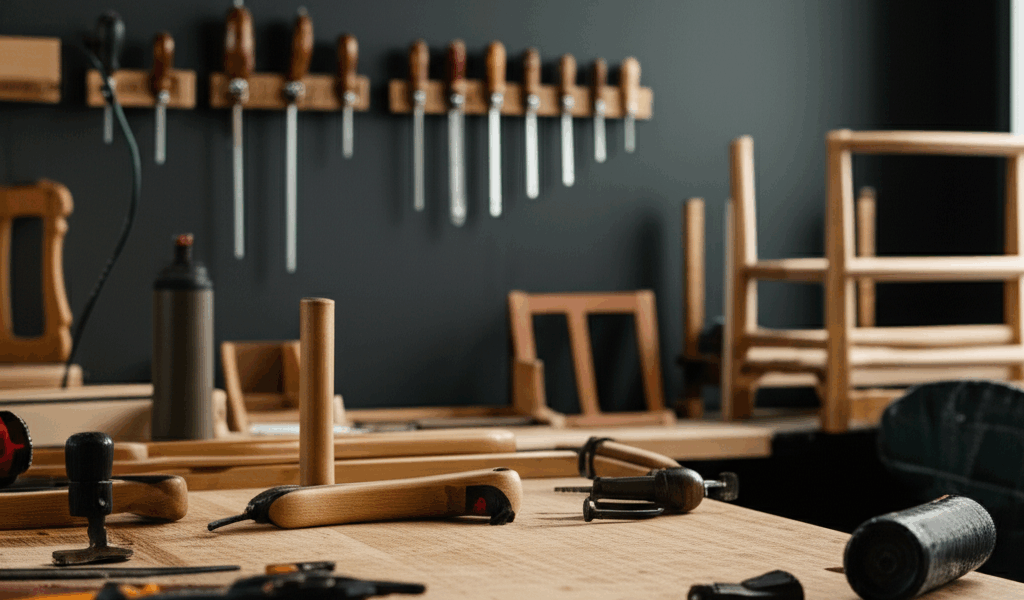
Every woodworker eventually dreams of the perfect shop. Maybe you’re converting a garage, finishing a basement, or building a dedicated structure from scratch. Whatever your starting point, thoughtful design separates functional workshops from frustrating ones.
Start With the Work Triangle
Kitchens have their work triangle between sink, stove, and refrigerator. Workshops have one too: the path between your primary workbench, table saw, and assembly area. These three zones see the most traffic during any project.
Keep this triangle tight. Every extra step between frequently-used stations multiplies across hundreds of trips during a project. Ideally, you should reach your table saw within three or four steps from your workbench, with your assembly area similarly close.
Plan these positions first, then arrange supporting equipment around them. Secondary machines—bandsaw, drill press, jointer—cluster at the triangle’s edges where you access them less frequently.
Understand Your Workflow
Wood moves through a shop in predictable stages: rough lumber enters, gets dimensioned, shaped, assembled, and finished. Design your layout to follow this flow.
Position your lumber storage near the shop entrance—you don’t want to carry heavy boards past finished projects. Place your jointer and planer nearby for initial dimensioning. The table saw and workbench occupy the center where most work happens. Assembly and finishing areas sit furthest from the entrance, where dust disturbance matters most.
This flow-based approach prevents backtracking. Material moves steadily through your shop rather than crisscrossing between stations.
Calculate Your Space Requirements
Standard equipment needs more room than beginners expect. A table saw requires infeed and outfeed clearance for 8-foot sheets—that’s 17 feet minimum in one direction. Add space to stand beside the blade and you need roughly 10 by 17 feet for table saw operations alone.
Essential space calculations:
- Table saw: 10′ × 17′ (including sheet goods handling)
- Workbench: 6′ × 10′ (including circulation)
- Bandsaw: 5′ × 8′ (for resawing long boards)
- Drill press: 4′ × 4′ (compact footprint)
- Assembly table: 6′ × 8′ (access from all sides)
- Lumber rack: 2′ × 8′ wall space minimum
A functional one-person shop needs 200 square feet minimum. Comfortable working space starts around 400 square feet. Professional shops often exceed 800 square feet.
Plan for Dust Collection
Dust collection determines equipment placement more than most woodworkers realize. Long duct runs reduce suction dramatically—a 25-foot run to your table saw might deliver half the airflow of a 10-foot run.
Position your dust collector centrally, with major machines arranged in a rough circle around it. Keep runs under 15 feet where possible. Use 4-inch main lines stepping down to 2.5-inch at machines that produce less dust.
Plan floor sweeps for areas like the workbench where you’ll generate shavings but lack a machine connection. Wall-mounted hose drops near each station eliminate tripping hazards from hoses snaking across the floor.
Electrical Layout Matters
Insufficient electrical capacity frustrates woodworkers more than almost any other oversight. Plan for current needs and future expansion.
Most shops need a dedicated 20-amp circuit for the table saw, another for the dust collector, and multiple general-purpose circuits for portable tools and lighting. If you’re running a 3HP cabinet saw or large planer, plan for 220-volt service.
Install outlets every 6 feet around the perimeter—you’ll use more than you expect. Ceiling-mounted retractable cord reels eliminate floor clutter in the center of your shop. Include outlets at workbench height for easy access without bending.
Lighting Changes Everything
Woodworking demands seeing fine details: layout lines, grain direction, surface defects. Poor lighting causes mistakes and eye strain.
Aim for 50-75 foot-candles of ambient light—roughly double typical garage lighting. LED shop lights at 5000K provide daylight-balanced illumination that reveals wood colors accurately. Supplement with task lighting at critical stations.
Position overhead lights to minimize shadows at your workbench and table saw. Light from multiple angles fills shadows better than a single bright source. Consider your working positions—standing at the bench, leaning over the table saw—when placing fixtures.
Floor Considerations
Standing on concrete all day punishes your body. Anti-fatigue mats at primary stations reduce joint stress significantly. Some woodworkers pour self-leveling epoxy with rubberized additives across their entire shop floor.
Seal concrete floors to prevent dust from migrating up from the slab. Painted or epoxy-coated floors also make sweeping easier and brighten the space by reflecting light upward.
If starting from scratch, consider a slightly sloped floor toward a central drain—useful for washing down dusty floors and inevitable spills during finishing.
Storage Integration
Tools without homes create clutter. Design storage into your shop from the start rather than adding it piecemeal.
French cleat systems on walls hold everything from hand tools to heavy jigs. Install cleats on every available wall surface—even walls you think you won’t use. Storage needs always exceed expectations.
Built-in lumber racks keep stock organized and accessible. Position them where fork truck or hand-carry access makes loading easy. Vertical storage for sheet goods saves floor space but requires clearance height.
Under-table storage utilizes otherwise dead space beneath assembly tables and workbenches. Mobile bases let you roll equipment aside to access stored materials.
Climate Control
Wood moves with humidity changes. A shop without climate control subjects your projects—and your tools—to damaging moisture swings.
In humid climates, dehumidification prevents rust and keeps lumber stable. In dry climates, some humidity helps prevent wood from checking. Either way, insulation pays dividends in comfort and energy costs.
Heating options range from forced air (dusty but effective) to radiant floor heat (comfortable but expensive) to wood stoves (atmospheric but requiring attention). Whatever you choose, avoid propane heaters that add moisture to the air.
Phased Implementation
Few woodworkers build their dream shop all at once. Design with phases in mind:
Phase 1: Core work triangle (bench, table saw, assembly), basic dust collection, essential lighting, minimum electrical.
Phase 2: Secondary machines (bandsaw, jointer, planer), expanded dust collection, additional circuits.
Phase 3: Finishing area, climate control, optimized storage, upgraded lighting.
Leave room for phase 2 and 3 equipment even if you can’t afford it yet. Moving a dust collector trunk line later costs far more than routing it correctly during initial installation.
Start Planning Today
Grab graph paper and sketch your available space. Mark fixed elements—doors, windows, electrical panel, water heater. Position your work triangle, then arrange supporting equipment around it. Live with the sketch for a week, mentally walking through typical projects.
The time you spend planning pays back every day you work in the finished shop. A well-designed workshop doesn’t just function better—it makes woodworking more enjoyable.



Stay in the loop
Get the latest the workshop journal updates delivered to your inbox.