Why Dado Width Goes Wrong
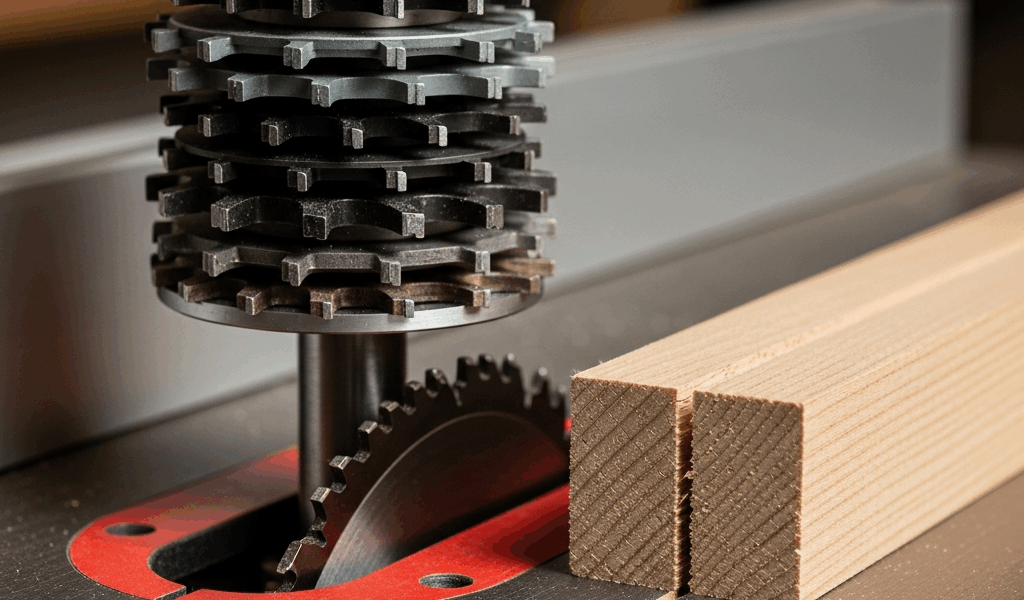
Dado stack setup has gotten complicated with all the conflicting advice flying around. I’ve stood at my tablesaw — a Ridgid R4512, if you’re curious — with a freshly assembled stack, cut a test piece, measured it with my Mitutoyo 500-196-30 calipers, and found myself half a thousandth of an inch too wide. Again. As someone who builds cabinet doors and face frames for a living, I learned everything there is to know about dado stack frustration. Today, I will share it all with you.
Turns out it almost always traces back to two things. Not ten. Two. First: chippers aren’t seated flat against the arbor — they rock slightly, opening the kerf by a few thousandths. Second: your outside blades have runout. Even a brand-new blade wobbles maybe .003″ if the arbor isn’t perfect, and that adds straight to your width. Most dado stack guides skip both of these and jump immediately to “measure with calipers.” That’s the finish line, not the starting block.
How to Read Your Dado Stack Before You Build It
Probably should have opened with this section, honestly. Most woodworkers grab their stack manual and do exactly what I did for three years: add up the numbers printed on the chippers and expect to get that width in the wood. That math doesn’t work. Not even close.
But what is a dado stack combination chart? In essence, it’s a manufacturer-tested reference showing exactly which chippers and shims produce which widths. But it’s much more than that — it accounts for blade body thickness, chipper seating, and real-world kerf instead of theoretical arithmetic.
Here’s the actual system. Your stack has two outside blades. Each one runs about .087″ thick. That’s .174″ of kerf right there before a single chipper touches the arbor. Then you layer chippers between them. A standard 1/8″ chipper isn’t really 1/8″ — it cuts 1/8″ wide, but its body sits on the arbor at a thinner dimension. The manual that came with your set — mine was a Freud SD508 10″ stack, bought in 2015 for around $189 — shows a combination chart. Use it religiously.
Let me walk through targeting 3/4″ with a typical setup. Your two outside blades give you .174″. You need another .576″ from chippers. The chart says one 1/2″ chipper plus one 1/16″ chipper, staggered and shimmed, gets you .749″ to .751″. You don’t just add .500″ plus .250″ and expect to get lucky. The chart does the math so you don’t have to guess.
Write down the combination before you touch the arbor. Keep the manual taped to the side of the saw cabinet. I stopped guessing the moment I started doing this. Don’t make my mistake and skip this step for three years.
Building the Stack and Seating It Correctly
Your arbor sits horizontal. Arbor nut on the right, blade mounting surface to the left. Start with one outside blade — teeth pointing away from you, flat side flush against the arbor shoulder. Not cocked. Not tilted. Flat. Run your fingernail around the perimeter and feel for any gap.
Now the chippers. This is where people consistently fail. The teeth on two adjacent chippers must never touch each other. Stagger them so the teeth of one chipper fall into the gullets of the next. I use a simple visual check — spin the arbor by hand with power off and watch the teeth pass each other. If they collide, you’ll hear a distinct click-click-click and feel resistance. Stop. Rotate one chipper 45 degrees and try again. You’re done when the spin is completely silent.
Shims matter more than most people think. A shim is a thin steel washer, typically .005″ or .010″ thick — Freud sells a shim kit for about $12. If your chipper combination lands at .745″ and you need .750″, you add one .005″ shim seated between a chipper and the arbor. Wipe the arbor shoulder clean before every single shim placement. No dust. No sawdust packed into corners. A single particle under a shim creates a gap and ruins your width — I’ve confirmed this personally more times than I’d like to admit.
Finish with the second outside blade, teeth pointing toward you, flat side pressed against the stack. Hand-tighten the arbor nut first. Then use a 5/8″ socket wrench and torque it to spec. Mine calls for 25 foot-pounds. Loose stacks rattle under load and widen the kerf unpredictably.
Test Cuts and Dialing In the Final Width
Run the saw. Cut a piece of pine or poplar — roughly 2″ long and 4″ wide. Stop, wait for the blade to come to a complete stop, then pull it out and measure the groove. Use calipers. A tape measure reads to 1/16″ on a good day. Your Mitutoyo — or honestly even a $25 Neiko digital caliper — reads to .001″. That’s what this work requires.
So your target is .750″ and you got .752″? You’re close. Don’t panic and disassemble the whole stack. Remove two .005″ shims and test again. Now you’re at .742″. Add back one shim. Test again. You’re at .747″. One more shim puts you at .752″ — which is honestly acceptable for most grooved panels, since the wood compresses slightly during glue-up assembly anyway.
I’m apparently obsessive about fit, and the sneak-up method works for me while eyeballing it never does. Say you’re cutting a groove for a 3/4″ plywood panel that actually measures .748″ off the planer. Start wider than needed — around .755″ — then remove shims in .005″ increments until your test groove accepts the panel with fingernail pressure. Not hammer pressure. Fingernail pressure. That’s the fit you want.
Wood species matters too. A white oak panel behaves completely differently from poplar. Oak compresses almost nothing under clamping pressure. Poplar crushes fairly easily. I fit oak snug at .750″ dead and poplar at .752″ to give it room to move. That’s a hard-won $200-worth-of-ruined-panels lesson right there.
When the Width Is Still Off After Setup
You’ve followed every step and the kerf is still .755″ when you need .750″. That’s frustrating — I know that feeling specifically. Start here, in order, and don’t skip ahead.
First, remeasure each stack component individually without cutting. Pull the arbor nut, slide the stack off, lay everything flat on a surface plate, and mic each piece. Write down the actual widths. Compare them to the manual specs. If your 1/2″ chipper actually measures .498″ and your 1/8″ chipper measures .126″, your math changes and so does your shim strategy. A warped chipper reads differently depending on where along its face you measure — that’s a bad chipper. Replace it. Freud sells individual replacements for around $15 to $22 depending on width.
Second, check arbor runout. Loosen the outside blade and spin the arbor by hand with a dial indicator touching the blade face. If it deflects more than .003″, you have an arbor runout problem. That’s a saw problem — not a stack problem. You need bearing service or full arbor replacement. Expensive? Yes. Your fault? No.
Third, check throat plate clearance. Loosen the stack, rotate it slowly by hand, and examine the kerf opening at the throat plate. If the throat plate edge sits lower than the kerf depth, particles jam underneath and the effective width opens up during the cut. File the throat plate opening slightly deeper or swap it for an aftermarket zero-clearance insert. A $20 part from Woodcraft solves this completely.
Do those three checks in that exact order. Most width problems collapse at step one or step three. That’s what makes systematic troubleshooting endearing to us woodworkers — it rewards patience over guesswork. If you reach step two and confirm runout beyond .003″, get the saw serviced before you blame the stack one more time.


Stay in the loop
Get the latest the workshop journal updates delivered to your inbox.