You are shopping for a miter saw and the word “sliding” keeps showing up in listings. A sliding compound miter saw costs $100 to $300 more than a non-sliding version, and you are trying to figure out whether the sliding feature is worth the premium. The short answer: it depends entirely on the width of the material you cut. Here is what the sliding mechanism actually does and when you need it.
What the Sliding Mechanism Does
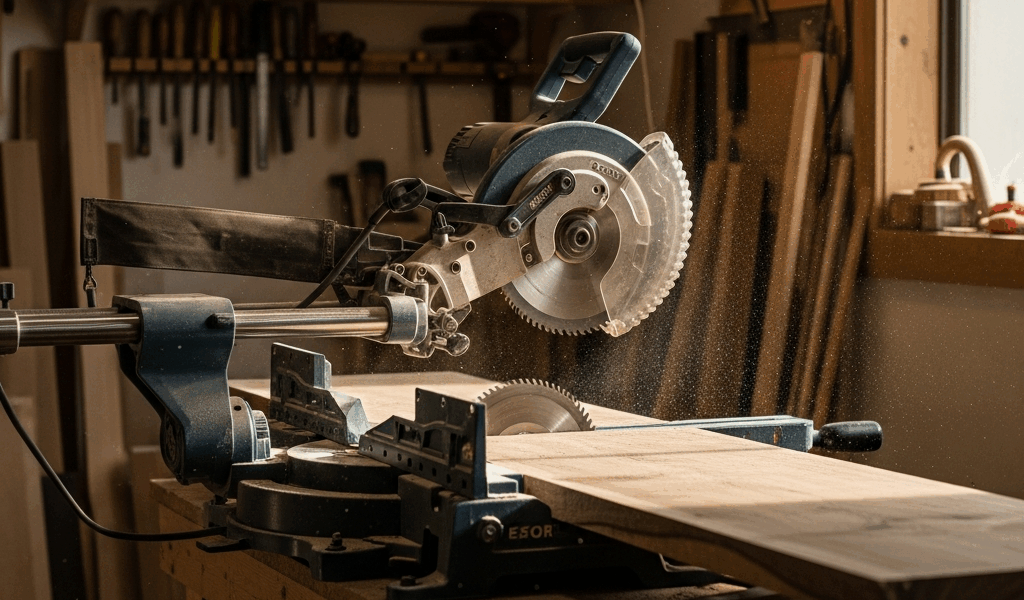
A standard compound miter saw plunges straight down through the workpiece — the blade drops on a hinge and cuts. The maximum cut width is limited by the blade diameter. A 12-inch blade on a non-sliding saw cuts about 7.5 to 8 inches of width. A 10-inch blade cuts about 5.5 to 6 inches.
A sliding compound miter saw adds horizontal rails that let the blade travel forward and backward during the cut. This extends the crosscut capacity significantly — a 12-inch sliding saw typically cuts 12 to 16 inches of width. A 10-inch sliding saw cuts 10 to 12 inches. You pull the blade toward you, plunge into the wood, and push it back through the cut.
That extra width capacity is the entire value proposition. If you never cut material wider than 6 inches, a sliding saw offers zero advantage. If you regularly cut wide boards, shelving material, or wide crown molding, the sliding feature is not optional — a non-sliding saw physically cannot make the cut.
When You Need a Sliding Miter Saw
Crosscutting wide boards. If you work with 1×10, 1×12, or wider boards for shelving, furniture, or built-ins, a non-sliding 10-inch miter saw cannot cut them in a single pass. You either need to flip the board and make two cuts (imprecise) or use a sliding saw that handles the full width cleanly.
Crown molding. Wide crown molding (5.25 inches and up) nested flat on a standard miter saw exceeds the cut capacity of most non-sliding saws. A sliding 10-inch saw handles it without gymnastics. If you are doing interior trim work, this alone justifies the sliding feature.
Sheet goods crosscuts. Cutting plywood shelves or MDF panels across the narrow dimension on a miter saw is faster than setting up a table saw for a single crosscut. A sliding saw with 12+ inches of capacity handles these cuts accurately.
Deck building. Composite and hardwood decking boards are typically 5.5 inches wide — right at the limit of a non-sliding 10-inch saw. A sliding saw provides clearance and makes angled cuts on wider boards possible.
When a Non-Sliding Saw Is Enough
Trim carpentry with standard molding. Baseboard, casing, and chair rail under 4 inches wide cut cleanly on any 10 or 12-inch compound miter saw without slides. If your primary work is interior trim installation, you are paying for sliding capacity you will rarely use.
Framing cuts. 2×4, 2×6, and 2×8 lumber fits within the capacity of a 10 or 12-inch non-sliding saw for most cuts. A 12-inch non-sliding saw handles 2×8 at 90 degrees comfortably. Framing rarely requires the extra width a sliding saw provides.
Portability matters. Sliding saws are heavier and bulkier — the rails add 10 to 20 pounds and extend the saw’s depth significantly. If you carry your saw to job sites regularly or work in tight spaces, a compact non-sliding 10-inch saw is significantly easier to transport and set up. The DeWalt DWS713 (non-sliding 10-inch) weighs 35 pounds. The DeWalt DWS779 (sliding 12-inch) weighs 56 pounds. That is a meaningful difference at 6 AM carrying it out of the truck.
The Best Sliding Compound Miter Saws in 2026
Best overall: DeWalt DWS780. 12-inch blade, 16-inch crosscut capacity, integrated XPS LED cut-line system, dual bevel, and the build quality that makes DeWalt the default recommendation on job sites. Accurate out of the box, holds calibration well, and the sliding mechanism runs smooth with minimal play. Street price around $500-600.
Best 10-inch: Bosch GCM18V-12SN (cordless) or Bosch CM10GD (corded). Bosch uses an axial-glide system instead of traditional rails — the saw head glides on an articulating arm that takes up less space behind the saw. This means you can push it against a wall without the rails interfering. The cut quality is excellent and the glide mechanism is remarkably smooth. The cordless version runs on 18V Profactor batteries and cuts as well as corded saws in testing.
Best value: Metabo HPT C10FSHCT. 10-inch sliding compound miter saw with a 12-inch crosscut capacity, laser guide, and a surprisingly solid build for its $250-300 street price. It lacks the refinement of the DeWalt and Bosch but cuts accurately and handles the width that budget-conscious woodworkers need. The micro-adjustable miter stops are a nice touch at this price point.
Best compact: Makita LS1019L. 10-inch sliding saw with a unique direct-drive motor design that eliminates the rear rails entirely. The saw head slides on internal mechanisms, giving you a full sliding cut capacity with a footprint barely larger than a non-sliding saw. Ideal for small shops and tight job sites where space behind the saw is limited.


Stay in the loop
Get the latest the workshop journal updates delivered to your inbox.