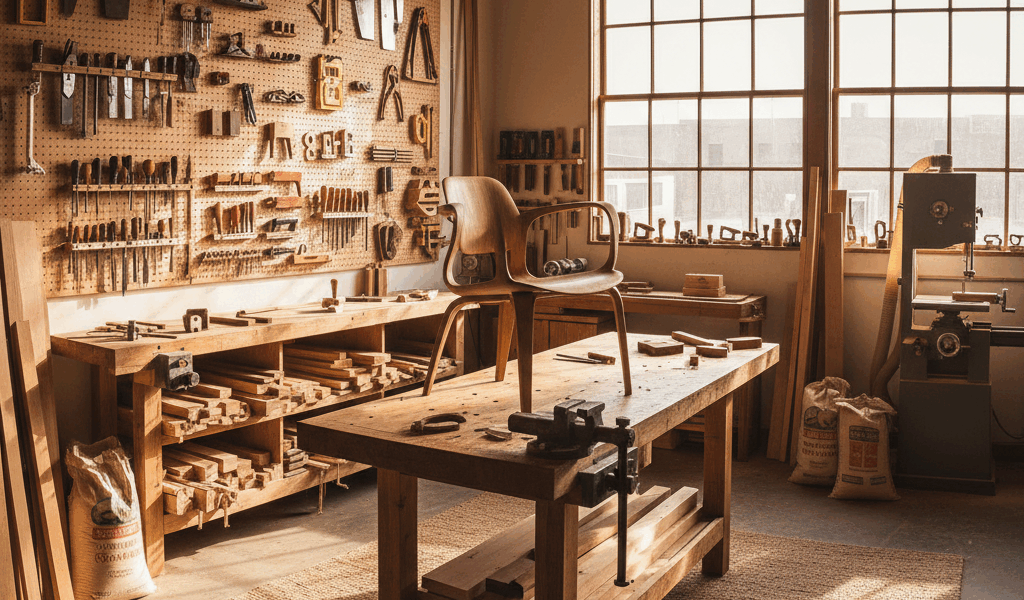
The workshop you’re imagining probably needs more space than you think. That two-car garage conversion that seems generous on paper starts feeling cramped the moment you actually try to build furniture in it. Understanding what workshop sizes mean in practice—not just in square footage—prevents disappointment and wasted investment.
I’ve worked in shops ranging from a cramped 10×12 shed to a proper 30×40 standalone building. Each taught me something about what matters and what doesn’t when it comes to workshop dimensions.
The Minimum Viable Workshop
You can do real woodworking in 100 square feet. People have built fine furniture in basement corners, storage sheds, and apartment balconies. Constraints force creativity and discipline about tool selection and material handling.
But “can do” isn’t the same as “should choose.” The minimum viable workshop works only when you’ve carefully selected tools for compact spaces, develop elaborate routines for material handling, and accept that certain projects simply won’t fit.
Below about 200 square feet, every operation becomes a dance of moving materials and repositioning tools. A single sheet of plywood can’t rotate in the space. Assembly requires taking partially-built projects outside. The shop serves as a tool room, not a building space.
The One-Car Garage Standard
A typical one-car garage provides roughly 12×20 feet—240 square feet. This represents the most common workshop scenario for home woodworkers. It’s enough space to be functional but not enough to be comfortable.
In 240 square feet, you can fit a table saw, a workbench, and either a bandsaw or a planer—not both unless one is mobile. Storage must climb the walls. Material storage happens outside the shop or consumes precious floor space.
The key to making small shops work is mobility. Everything that can roll should roll. The table saw moves aside for jointer work. The assembly bench clears for finishing. The constant reconfiguration becomes part of the process.
I worked in a shop this size for three years. Projects happened, but the space friction slowed everything down. What should have taken an afternoon took a weekend because so much time went to shuffling equipment.
The Sweet Spot
Workshops between 400 and 600 square feet hit a sweet spot for serious hobbyists and part-time professionals. This size—roughly a two-car garage—allows dedicated stations that don’t need constant rearrangement.
At 500 square feet, the table saw can live in the center with enough infeed and outfeed clearance for full sheets. A proper workbench with surrounding access becomes possible. Lumber storage happens inside without dominating the space.
The psychological difference matters as much as the practical difference. Walking into a shop where you can actually start working—rather than spending the first twenty minutes rearranging—changes your relationship with the craft. You build more because building is easier.
Most woodworking magazines and YouTube channels feature shops in this range. It’s enough space to look organized on camera while remaining attainable for serious hobbyists with reasonable budgets.
Professional-Scale Spaces
Above 800 square feet, you’re entering territory that professional shops occupy. The economics change—this much space costs real money in construction, heating, and maintenance. Unless woodworking generates income or you’ve committed to it as a major life focus, this scale is hard to justify.
But the work that becomes possible in larger spaces is qualitatively different. A 30-foot-long assembly table for glue-ups. Dedicated finishing areas isolated from dust. Machine placement optimized for workflow rather than footprint. Lumber storage that allows proper drying and selection.
Professional one-person shops often run 1,000-1,500 square feet. Shops with employees or extensive machinery libraries can be much larger. At some point, more space creates management challenges that offset the advantages.
Ceiling Height Matters
Floor space gets all the attention, but vertical dimension affects what you can do as much as horizontal dimension.
Eight-foot ceilings work but create constant awareness of overhead clearance. Raising a long board past vertical—necessary for flipping stock and some machine operations—risks hitting the ceiling. Lighting and dust collection ducting consume the limited headroom.
Ten-foot ceilings transform the feeling of a shop. Long boards maneuver freely. Overhead dust collection runs where it should. The space feels open rather than compressed.
Twelve-foot or higher ceilings enable mezzanine storage—essentially free square footage for material and seasonal storage. Some shops add catwalks for long-board storage that would otherwise consume floor space.
Shape and Configuration
A 20×25 shop works very differently than a 10×50 shop, though both contain 500 square feet. Workflow, machine placement, and material handling all depend on proportions.
Squarish spaces allow central machine placement with surrounding access. The classic shop layout—table saw in the middle, workbench along one wall, secondary machines around the perimeter—works best in proportions close to 1:1 or 1:1.5.
Long narrow spaces force linear workflows. Operations proceed from one end to the other, which works fine for some processes but creates problems when you need to move repeatedly between stations. A bandsaw at one end and a drill press at the other means lots of walking.
L-shaped and irregular spaces challenge shop design but often exist in garages and basements. Working with the space rather than against it—using corners for storage, placing machines to take advantage of natural zones—makes the most of difficult footprints.
The Decision
Choose the largest space you can reasonably afford and access. Workshop size is one area where more is almost always better, at least up to the point where the space creates maintenance burdens that interfere with actually using it.
If you’re choosing between options, prioritize height over footprint for spaces under 500 square feet. A smaller shop with tall ceilings outperforms a larger shop with cramped overhead clearance.
Plan for growth. The tools you own today won’t be the tools you own in five years. The 200-square-foot shop that fits your current setup will feel constrained after you add a jointer and planer. Build or allocate more space than you think you need, and you’ll eventually need it.


Stay in the loop
Get the latest the workshop journal updates delivered to your inbox.